
Free Printable Sourdough Starter Calendar (60g Feeding Method)
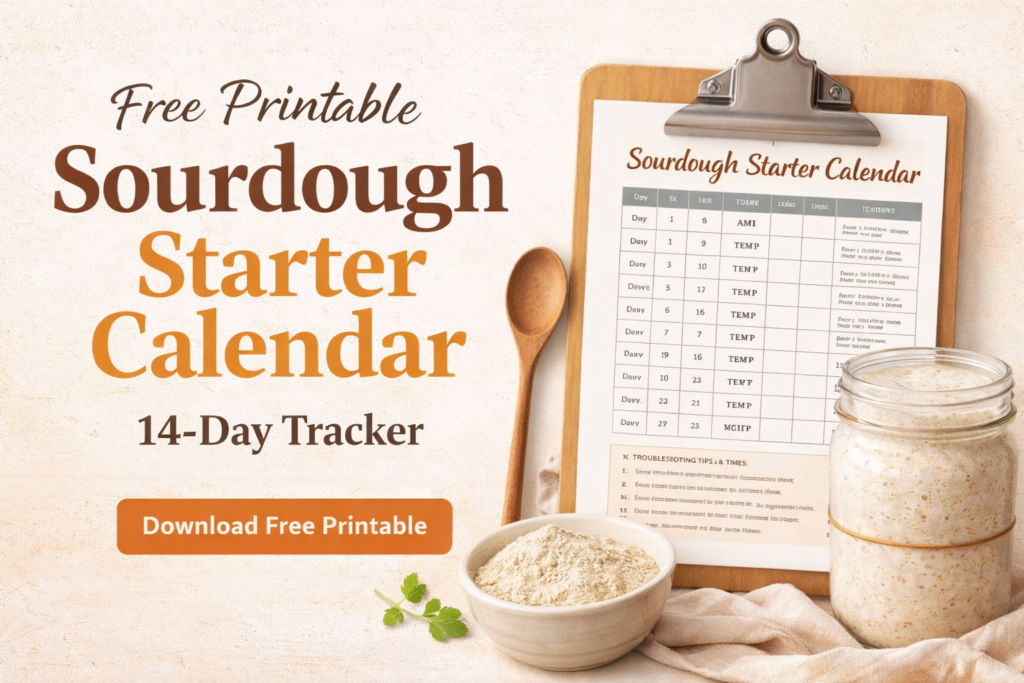
The Sourdough Tracker That Made My Starter Finally Make Sense
How I use a simple scale, an extra jar, and a printable tracker to build, maintain, and bake with a mature sourdough starter.
There is something deeply satisfying about sourdough.
It is simple in theory — flour, water, time, and patience — but in real life it can feel like you are trying to understand a moody little kitchen creature with a personality of its own. One day your starter is bubbly, active, and ready to rise like a champion. The next day it looks sleepy, smells different, and leaves you wondering what changed.
That was exactly why I decided to start tracking mine.
At first, I thought I could just remember what I was doing. I figured I would know when I fed it, what flour I used, whether it rose well, and how warm the kitchen was. But after a few days, then a week, then another week, I realized I was guessing way too much.
Did I feed it this morning or last night?
Was this the day I used bread flour?
Did it peak faster when the room was warmer?
Was it actually improving, or did I just think it was?
That’s when I made a sourdough tracker.
Not because I wanted to overcomplicate bread baking. Actually, the opposite. I wanted to make it simpler. I wanted a way to look at what was happening and understand the rhythm of my starter without relying on memory alone.
And honestly, it helped more than I expected.
Why a Sourdough Tracker Matters
Sourdough starters change based on temperature, flour type, feeding frequency, hydration, and timing. A starter can seem strong one week and sluggish the next just because the kitchen is a few degrees cooler or you changed your flour.
That is what makes sourdough so fascinating — and also what makes it frustrating.
A good tracker turns all that mystery into patterns.
Instead of wondering why your starter is slow, you can look back and see that maybe your kitchen dropped below your ideal range. Instead of feeling like your starter is failing, you can notice that the strange smell you got in the early days is actually part of development. Instead of guessing when it is ready to bake, you can start seeing its rhythm clearly.
The Method I’m Using
The tracker I’ve been working with is built around a simple 60 gram method. The formula is easy to remember: keep 60 grams of starter, then add 60 grams flour and 60 grams water. It is approachable, repeatable, and easy to track.
I like that this method is straightforward enough for beginners but still useful for more experienced bakers who want consistency.
The flour can be flexible too. You can use all-purpose flour, bread flour, or a mix that includes whole wheat if your starter needs extra strength. The room temperature matters as well. A healthy starter in a warm kitchen behaves very differently than one trying to wake up in a cold room.
The Simple Scale Method I Use
One thing that makes sourdough dramatically easier is using a food scale.
Instead of guessing measurements or using cups, I weigh everything in grams. It keeps the ratios consistent and removes a lot of the guesswork from feeding a starter.
My daily routine is very simple.
First, I place an extra empty jar on the scale and tare it to zero. Then I remove about 50% of the starter and place that discard into a larger jar. After that, I feed what remains in the main jar.
Because everything is weighed, the process is fast, clean, and consistent every time.
- Keep 60 grams starter
- Add 60 grams flour
- Add 60 grams water
Using a scale is one of the biggest reasons this feels manageable for me. I do not have to eyeball anything. I do not have to dirty extra bowls. I just weigh, feed, stir, and move on.
Why I Keep a Discard Jar
The discard jar is one of my favorite parts of the system.
Instead of throwing starter away each day, I collect the discard in a large jar. That makes it easy to save for recipes later instead of wasting it.
Over a few days, it adds up enough to use in things like pancakes, crackers, pizza dough, muffins, or other discard recipes. It also keeps the daily process simple because I am not standing there deciding what to do with extra starter every time I feed it.
I just remove about half, add it to the discard jar, and keep going.
What the Early Days Taught Me
One of my favorite things about using a tracker is that it normalizes the messy middle.
When people first start sourdough, they often expect the starter to behave beautifully right away. But that is usually not how it works. There are awkward days where it smells weird, doesn’t rise much, or seems unpredictable.
That doesn’t automatically mean anything is wrong.
Tracking helped me stop overreacting and start observing. Once I began recording what I saw each day, I realized that progress often happens in stages. A quiet day is not always a failed day. Sometimes it is just part of the process.
What I Track Besides Feedings
The calendar structure is helpful on its own, but what really made this process click for me was adding notes.
A sourdough tracker becomes much more powerful when you write down what you notice, not just what you did.
For me, the most useful things to record are:
- whether the starter had lots of bubbles or just a few
- how long it took to rise
- whether it doubled or only grew a little
- how it smelled
- whether the texture seemed thick, airy, runny, or sticky
- what the kitchen temperature felt like
- whether I changed flours or ratios
That notes section matters more than people think. A starter leaves clues, and once you start writing them down, you learn its personality.
Starting a Second Starter
After about seven days, once things are going well, I usually start a second starter.
The reason is practical: I use about 120 grams of active starter to make one sandwich loaf in my 5×13 pan. Having a second starter makes that a lot easier.
Instead of stressing one jar or scrambling to build up enough active starter at the last minute, I can split and feed more confidently. It gives me more flexibility when I know I want to bake.
It also acts like a backup, which I really like. If one jar gets neglected or does something strange, I still have another one going.
The Float Test Isn’t the Whole Story
I know the float test gets mentioned a lot, and it can be helpful, but I do not treat it like the only answer.
If my starter is doubling reliably, smells pleasantly tangy and yeasty, and shows strong bubbles at peak activity, that matters more to me than one single moment in a glass of water.
Tracking helped me trust the bigger pattern instead of obsessing over one test.
Refrigerating the Starter During the Week
Once my starter has matured, I do not keep it out on the counter all the time.
Since I am not baking every weekday, I refrigerate it during the week. That slows everything down and makes the routine much more realistic for normal life.
Then, about two days before I plan to bake, I bring it back out, feed it, and split it as needed. That gives it time to wake back up, build strength, and get active again before baking day.
This has been a really good middle ground for me. I still get the benefits of maintaining a mature starter, but I am not chained to daily feedings when I am not actually using it.
Why This System Works Well
This routine keeps sourdough simple.
- Using a scale keeps the feeding consistent.
- An extra jar makes it easy to tare the scale and remove discard cleanly.
- A discard jar prevents waste and gives you ingredients for other recipes.
- A second starter adds flexibility for regular baking.
- Refrigeration lets the starter rest between bakes once it is mature.
It turns sourdough from something that demands daily attention into something that fits naturally into my kitchen routine.
And once it becomes part of your rhythm, it stops feeling complicated and starts feeling like second nature.
Download the Sourdough Starter Tracker
If you want to follow the same method I use, you can download the printable tracker here.
The tracker is helpful for recording feedings, activity, rise time, smell, and observations while your starter matures. It is simple, practical, and easy to keep nearby while you work.
You can print it out, keep it near your jars, or tape it inside a cabinet door so it is easy to update each day.
Final Thoughts
The sourdough tracker started as a practical tool, but it has become one of my favorite parts of the process.
It gives shape to something that can otherwise feel unpredictable. It helps me understand what my starter needs. It reminds me that bread baking is not just about results — it is about rhythm, observation, and learning as you go.
If you have been thinking about starting sourdough, this is a good place to begin.
Not with perfection.
Not with fancy equipment.
Just with a jar, some flour, some water, and a way to pay attention.
That is usually where the best things begin.
Coming Next: My 5×13 Sourdough Sandwich Loaf
Once your starter is mature and active, the next natural step is baking with it. My go-to sandwich loaf uses about 120 grams of active starter and fits a 5×13 loaf pan. It is the kind of bread that works beautifully for toast, sandwiches, and everyday slicing.
If you are following along with this starter process, that loaf is the perfect next recipe.
Resources
Downloads & Resources
Browse downloadable resources, guides, worksheets, and tools.
Free Printable Sourdough Starter Calendar (60g Feeding Method) – Printable
Facebook Share on X LinkedIn WhatsApp Email Copy Link
Free Printable Sourdough Starter Calendar (60g Feeding Method) – Plain Format
Facebook Share on X LinkedIn WhatsApp Email Copy Link
Leave a Reply